White Baby Looks at Black Woman and Smiles
Source: Everyday Feminism
Got questions nearly why people get mad when white folks wear traditionally Black hairstyles? Well, you lot've come to the correct identify – I'm i of those people who'southward riled upwards nearly it, and I've got answers.
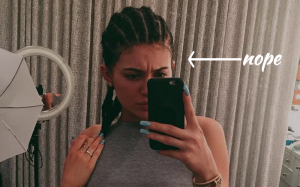
Many people are wondering about this topic after the near recent public example of Black pilus cribbing: Kylie Jenner's cornrows.
And so maybe your first question is this: Why the hell do I care about what some teenager does with her hair?
Here's your answer: This conversation isn't but most hair. And it'due south non just nigh Kylie Jenner. Her latest iteration of cultural cribbing is just a drop in the bucket that's been filling up for centuries.
Then if this seems to you similar a picayune issue, don't worry – we're going to become to why information technology really matters.
Just since this incident started this current conversation, here'due south what'south going on with Kylie:
The white, younger sis of Kim Kardashian posted a photograph of herself wearing cornrows.
And so, 16-twelvemonth-quondam Amandla Stenberg (best known for playing Rue on The Hunger Games before becoming best known for inspiring widespread awe with her summary of cultural cribbing) made me applaud my figurer screen again. She pointed out exactly what's wrong with this picture:
Jenner's using her fame to call attention to her pilus, which mimics Black culture, just not to the racist violence taking Black lives.
And so Justin Bieber defended Jenner – and the approval squeals of fangirls rang out 'round the globe. Now, the public is weighing in.
I can't believe I'thou about to say this, but the Biebs has a point hither. I don't concur that Jenner should be free from responsibility for her wrongdoing, but he's right when he says that she's just one girl who made a fault – and there's a bigger picture we need to pay attention to here.
We can showtime past talking about her hair, but if that'due south all we talk about, we'll miss the chance to learn something valuable well-nigh how mundane deportment, like the fashion you lot wear your hair, tin brand a huge argument about whether or non you lot value people of color who are struggling with the atrocities of oppression every day.
And you'll still be left with questions, similar why was this such a large deal? Let's reply your questions.
This is what the uproar over cribbing of Blackness women's hair is really all nigh.
1. "Why Can't Nosotros All Merely Be Equals and Share Our Cultures?"
I go it. I say I'm all about equality, but you call up I'm pulling for the opposite – stating that only certain people should wearable certain hairstyles based on skin color.
Simply at that place'southward one major particular you have to think most when it comes to equality: the reality we alive in.
Information technology's truthful that we're "all human, whether we're black, white, green, or majestic."
I've heard it all before, and it sounds pretty slap-up – all beingness treated so equally that you tin can wear any hairstyle y'all want without harming anyone.
In a truly equal world, yous wouldn't take to retrieve about if you have power and privilege over the people you're borrowing culture from.
Unfortunately, that'due south not the world we alive in. In our world, systems of oppression create ability dynamics betwixt different groups of people.
In the United States, for instance, white people get the unearned benefits of having the ascendant civilization.
And all of us – but peculiarly women – deal with a dominant epitome of beauty that'southward completely unrealistic. None of us are gratuitous from being body-shamed about all of the reasons our pilus, body, teeth, or skin are not what someone else says they should be.
Merely for women of color, that unrealistic beauty ideal is even further out of reach.
The popularity of Eurocentric images says that being cute means being white, and that "normal" hair is fine and silky – cipher like my kinky natural African hair.
That type of hair is considered such a norm that mainstream stores don't have products for me unless they're selling the chance to change – to permanently alter my hair's texture with straightening chemicals.
And institutional barriers discourage me from wearing my pilus as it grows out of my head – I'g more than likely to find and keep jobs if I run across standards of professionalism that oftentimes ban Black women'south natural hairstyles.
White women confront sexism, and they may exist oppressed in other ways, besides – through ableism, classism, or fatphobia, for example. Only when it comes to race, white women have more institutional power than Black women.
So while we should be treated equally equals, we're not . A white woman is free to take on and take off the same hairstyle that a Blackness woman would be ostracized for.
Until we right that imbalance, and so when Kylie Jenner wears cornrows, she'southward acting on privilege and exploiting Black civilization. She's participating in a toxic norm that says Black people aren't valuable, but our pilus is cool – as long as white folks are wearing it.
That's not okay. If she really thinks Blackness folks are absurd and wants to honor our culture, she should help eradicate the inequality between united states of america instead.
ii. "What Nigh When Blackness Women Straighten Their Pilus?"
Since gild treats white women every bit more valuable, Black women don't accept the same context when they make their hair wait more like the ascendant norm.
In the United states, people have a diversity of reasons for straightening their pilus, merely for many Blackness women, it's a thing of survival, not simply preference.
When you can't observe piece of work unless you exercise it, you have to accept such action to get by.
I can adjure to how differently people treat Blackness women depending on the mode of our hair. In one example from a lifetime of microaggressions, a high school teacher said my straightened hair looked "and then much better than those knots" I normally wore.
I'd straightened it temporarily, for a school dance. My 15-twelvemonth-one-time cocky was filled with the dreadful reminder that I'd exist considered less cute when I returned to my twists – the "knots" he'd sneered almost – after the style washed out in a couple days.
When a marginalized group takes on elements from the ascendant culture in order to survive, that's called absorption.
It's dissimilar from cribbing, when the dominant group takes from an oppressed group without respect for the civilization they're taking from.
I didn't always know the word "absorption," but I've always felt the pressure of it. Similar many other Black girls, I grew up with that pressure fifty-fifty inside my own family, from my mother, aunts, and grandmother, who were harshly ridiculed for kinky pilus.
In our family, the protective love women showed girls looked like teaching usa that our own hair was ugly and unkept.
Fifty-fifty now, things are slowly changing from how information technology was for them and I've constitute piece of work spaces open to my natural hair. Merely I couldn't tell my aunties that – if I ever end upward alone in a room with one of them, they're bound to try to take a straightening comb to my head for what they believe is my own good.
That's the lasting impact of the pressure to survive by fitting in with white culture.
A white adult female who wears dreadlocks is acting on her privilege to have that hairstyle and still get by, and even to become positive attending for her hair.
Meanwhile, a Blackness woman with dreads gets treated like she's junior merely considering her pilus doesn't look like a white person's. And then she's more likely to straighten it just to survive.
three. "Why Are You Trying to Limit Freedom?"
Peradventure you lot're stuck on the idea that if you're a white person, you "tin't" wear your hair a certain fashion.
That hinders your liberty. And every bit big fan of liberation, I become why that feels fucked up. It'due south your hair and you should be able to do whatever yous want with it.
A lot of people call back avoiding cultural appropriation means policing self-expression.
They say I'm calling for locking people up just for pain feelings.
Starting time, tin can I request that we ease upwards on the hyperbole when we talk about this? Because I'm not out to outlaw hairstyles, and we tin can refer to plenty of real-life consequences of cultural cribbing without exaggeration.
Cultural cribbing is never as simple every bit saying, "White people aren't immune to do X, period." It'south about saying it'southward ethical to consider the context of what you're doing.
That includes learning about and giving credit to the true significant of what you're borrowing, instead of doing what Iggy Azalea does and gaining fame and fortune by imitating someone else.
Information technology means recognizing where it came from, instead of doing what Elle UK just did and calling baby pilus "a new trend" when Black women have been wearing information technology for decades.
Information technology besides means leaving something lonely if you acquire that information technology's not possible to borrow it in a respectful style, like blogger HaifischGeweint did when they researched dreadlocks and decided not to wear them.
When people object to cultural cribbing, nosotros're not complaining for cypher – and it'due south insulting to say that we are. Because we're letting you know that even if you accept harmless intentions, your impact is causing harm.
As the people who accept to suffer through that harm, Blackness folks know what we're talking about when we say that appropriating our hairstyles is fucked up. There's a lot more at stake than limiting your "free speech" when you're actually contributing to other people'due south oppression.
iv. "Where Practice You Draw the Line? Why Are You Trying to Segregate People?"
One of the trickiest parts of cultural appropriation is knowing where to draw the line. People argue that we share between cultures all the time, which helps us abound as people.
And believe me, I know Black hair is gorgeous, so I appreciate that you want to appreciate it.
That's why there'due south a departure between cultural exchange – when people freely share appreciation for i another's cultures – and cultural appropriation.
If people can share every bit and do good without impairment, that's fantastic.
But then some people offset to wonder why we should draw lines between cultures – after all, nosotros're striving to exist equal, right?
I'm not trying to separate u.s.a.. But once again, let's consider reality: when information technology comes to things like who gets more positive representation in the media, and who's less likely to get killed by police, and who's more likely to find employment, at that place's a articulate difference between me and a white adult female.
The differences betwixt usa besides include things that should be celebrated. Being Black comes with disadvantages in this society, like being profiled and stereotyped, simply it also comes with things I love. I'k proud of my Blackness.
Then when someone takes a piece of what my Blackness ways to me, and puts information technology on similar my identity is a costume, I experience like that'southward all I am to them. Some minstrel show, some character, some two-dimensional stereotype of a person you tin can both mock and steal form.
It'due south the ultimate form of objectification.
If you lot care for my look like something y'all can borrow when information technology brings you lot value and discard when it becomes useless, and so y'all trivialize both my struggles and the cute things virtually what being Black ways to me.
Recall of it this way: Information technology's not segregation, but celebration. The problem is the unjust ways society treats our differences – non the fact that our differences exist.
5. "Are You Saying I'chiliad a Bad Person If I Have One of These Hairstyles?"
Information technology's hard to swallow the idea that you could be causing impairment when you don't want to.
That'due south why I'g not saying you lot're a bad person, even if you're guilty of appropriating another civilisation'due south traditional hairstyle. I don't know you or your intentions, and judging your character is not the point of pointing out how white supremacy shows upward. In brusque, it'south not just about you.
Just like this chat isn't just nearly Kylie Jenner's pilus, cultural appropriation isn't about saying any one individual person is evil. The indicate is to be aware of how systems of oppression show up in our everyday lives.
White supremacy is an instance of a organisation. The media is an case of a construction that supports white supremacy, past showing positive images of white people and negative stereotypes of people of color. And y'all are one individual who consumes media, and acts on the ways they influence your view of the world.
So if you've ever thought a white daughter with braids looked "quirky" and a Blackness girl with braids looked "ghetto," that'south not a sign that you lot're the 1 True Source of All Of White Supremacy.
Just information technology is an example of how white people equally individuals can participate in the system of white supremacy, and of how Blackness people can get hurt.
That's why changing our everyday deportment is a big function of creating change on a societal level.
six. "What If My Black Friend Says Information technology'due south Okay?"
Sorry, since cultural appropriation isn't about one private being a bad person, it'southward too not about one individual person giving y'all a laissez passer to do it.
Permit's exist clear: Talking to marginalized people about their experiences with oppression is a good way to get perspective on issues they're dealing with.
That's not to say it's a costless-for-all for request strangers questions and enervating answers. Nobody'south obligated to brainwash you, but it'south groovy if you take a friend who's willing to to talk to you when you lot arroyo them in a respectful way.
Merely it still doesn't mean their word stands for their entire culture.
No community is a monolith, and you could find a Black person who would say that appropriating our hair isn't not a problem. They could honestly feel that way, or they could be feeling the pressure to concur with the ascendant civilization.
I wish I could give you the magical formula for what makes something offensive: Add the number of studies published on it + your number of Black friends, dissever by the number of centuries this debate has raged on, sprinkle your intentions on top, and there y'all take information technology! Anything over 6 is wildly offensive.
It's just not that piece of cake. If one Black person says it'due south okay, you take ane person'due south opinion, and that'southward a beginning. But if y'all really desire your answer, y'all likewise have to mind to other perspectives, learn about being an ally Black folks, and acknowledge your own privilege.
Once you commit to that process, you'll understand a lot more nigh anti-Black racism – and you'll know what's at stake for Black folks if you advisable our hairstyles.
7. "I Don't Back up Racism, Then Why Is It a Problem If I Clothing a Traditionally Black Hairstyle?"
This is oftentimes accompanied by "Don't you have more than important things to worry about?"
Okay, I can already hear people trying to telephone call bullshit on my concluding point – it's "just hair," so what's actually at stake?
Well, let'southward review the impact of some of the examples I've mentioned so far. When a white adult female wears a traditionally Black hairstyle, she:
- Ignores the inequality of systematic racism, letting information technology remain invisible
- Distracts from the real effect of racism past leaving information technology up to people of color to point out the problem – then it'southward almost our "oversensitivity," rather than institutional oppression
- Adds to the Eurocentric standard of beauty that says that Black women'south features are adequate only on white women
- Claims profit, credit, and/or praise instead of the people of the culture she borrowed from
- Trivializes the struggles of the people who identify with that hairstyle
- Erases cultural differences that should be celebrated
- Perpetuates the system of white supremacy by reinforcing false ideas of Blackness women's inferiority
That'southward no small impact from one individual.
And when you think about lots of people believing cultural appropriation is okay, you tin can sympathise how this adds up to equal major issues.
Yeah, we do have things more of import than hair to worry about. I've touched on several of the important bug for Black women already – employment discrimination, lack of visibility in the media, police brutality – not to mention things similar healthcare, reproductive justice, and intimate partner violence.
So if you're wondering why I'd take whatever time abroad from these pressing issues to worry about pilus, the reply is that you've but stumbled upon one of the realities of Blackness women's everyday existence in the U.s..
We're suffering and invisible. There are feminists who fight for women but won't even acknowledge that our issues are worth fighting for. At that place are Black people speaking out against police brutality who don't speak the names of Black women killed by police.
We're told that we're not beautiful, specially not when nosotros look most like ourselves. Oftentimes, the same people who appropriate elements of our culture are completely absent when nosotros need support.
And and then we find a treasure that helps the states challenge those abusive narratives, helps usa recognize our value and exist proud of our heritage, even later on a lifetime of deposition. Fifty-fifty after being violently asunder from our ancestors and having our history erased, sometimes direct through suppression of our natural appearance.
And that treasure is our ain hair, which becomes more than but hair – nosotros grow to understand that it's one of the precious tools we can wield to aid us affirm our worth and embrace our roots.
Even if you don't contribute to these struggles, the fact is that Black women wrestle these conditions every day. If you hold that we deserve improve, then respect us plenty to let us determine for ourselves what we demand.
Your everyday actions don't exist in a vacuum divide from anti-Black racism, so if yous don't acknowledge the problem, and then you're function of information technology.
***
I hope this information clears upwardly whatsoever defoliation you had – not just about what Kylie Jenner's done wrong, but virtually the bigger moving-picture show of why cribbing of traditionally Black hairstyles is harmful.
You'll have more questions most how all of this applies to detail situations. Just at present you've got the fundamental: applying context.
If you're a white person cleaning your firm and you toss your hair into braids to keep it out of your face, of course nobody's going to arrest you lot for appropriating cornrows.
Simply if y'all happen to catch a glimpse of yourself looking quirky in the mirror and make up one's mind you'll tell the world you invented braids to gain profit, effort re-reading this article before calling your agent.
And if you're thinking that technically the Norse, or technically the Vikings, or technically some pale-skinned ruler in 2000 BCE had dreadlocks get-go – again, consider the context. Who, in this society, gets the brunt of negative stereotypes about dreadlocks?
With what you know about why Black women's hair matters, you lot can apply context to other situations of possible cribbing to figure out if what'south respectful and what'southward oppressive.
There are no easy answers, but with some thoughtfulness and intendance, you can assistance meliorate the abhorrent ways our society treats Black women – instead of being part of the problem of making our lives more of a struggle just and so you tin can have your fun.
Maisha Z. Johnson is the Digital Content Associate and Staff Writer of Everyday Feminism. Y'all can find her writing at the intersections and shamelessly indulging in her obsession with pop culture around the web. Maisha's past work includes Customs United Against Violence (CUAV), the nation'southward oldest LGBTQ anti-violence organization, and Fired Upwards!, a program of California Coalition for Women Prisoners. Through her own project, Inkblot Arts,Maisha taps into the creative arts and digital media to dilate the voices of those often silenced. Like her on Facebook or follow her on Twitter @mzjwords.
Source: https://everydayfeminism.com/2015/07/white-people-black-hairstyles/
0 Response to "White Baby Looks at Black Woman and Smiles"
Post a Comment